O'HAGAN LABORATORY
Research

O'Hagan Laboratory

Research

Research

Research programmes

We present four focused programmes that together connect transcriptional stress, DNA damage signalling and chromatin-mediated epigenetic change. Each programme uses complementary cellular and in vivo models with genomic and biochemical readouts.
01

Transcriptional stress, coupled repair and p53 activation

How does transcriptional blockage and stalled RNA polymerase link DNA damage sensing to p53 activation and cell fate decisions?

Transcriptional stress — for example caused by DNA lesions in active genes or by inhibition of elongation — produces discrete signalling events that recruit checkpoint factors and can rapidly stabilise/activate p53. We investigate the molecular intermediates (RPA, ATR and associated factors) that link stalled transcription complexes to canonical DNA damage checkpoint pathways and p53 modification, nuclear localisation and transcriptional responses.

By combining inducible locus-specific damage systems with genomic run-on assays, chromatin immunoprecipitation and proteomics, we map events from polymerase stalling to checkpoint kinase activation and the p53-dependent transcriptional programme that determines cell-cycle arrest, apoptosis or survival.
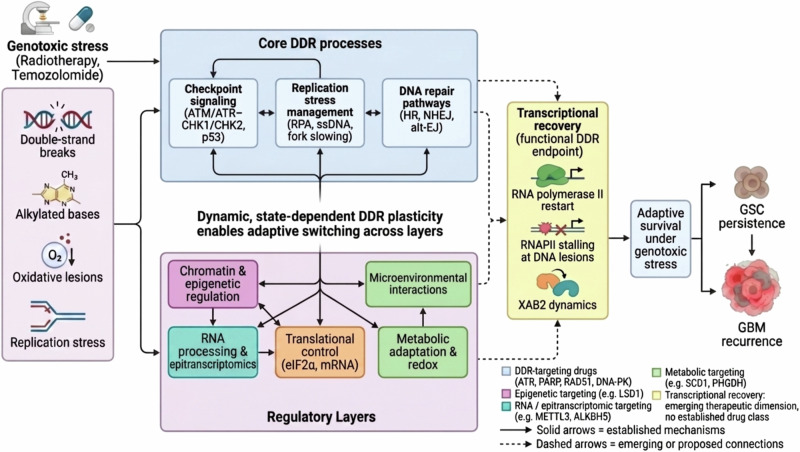
Published scientific figure relevant to Transcriptional stress, coupled repair and p53 activation.
02

Damage-induced recruitment of chromatin modifiers and onset of DNA methylation

What molecular events at sites of double-strand breaks or oxidative lesions recruit silencing complexes and how can these lead to de novo DNA methylation at promoters?

Using defined double-strand breaks in model promoter CpG islands, we have shown that chromatin silencers including SIRT1, polycomb members and DNA methyltransferases can be recruited to damaged loci and — under some circumstances — initiate CpG methylation and persistent silencing. Current work examines how repair pathway choice, local chromatin state and interacting repair proteins determine the probability of a transient damage event producing a stable epigenetic change.

We are particularly interested in interactions between repair proteins (for example mismatch repair factors) and DNMT recruitment after oxidative damage, and how inflammatory signals or repeated lesions bias outcomes toward heritable methylation changes during tumour initiation.

Protein complex enrichment at CpG-island promoters after oxidative damage (from O'Hagan et al., Cancer Cell 2011).
03

Inflammation, mismatch repair and initiation of epigenetic changes during tumourigenesis

How do inflammatory exposures cause targeted, heritable epigenetic alterations that predispose to cancer?

Chronic inflammation produces reactive species that damage DNA and alter chromatin. Our work dissects the cascade from inflammation-mediated damage to recruitment of mismatch-repair proteins (for example MSH2-MSH6), subsequent DNMT1 recruitment and local transcriptional repression. We test these mechanisms in inflammation-driven mouse models of colon tumourigenesis and in human tissue models.

We also study metabolic and mitochondrial consequences of inflammation-induced epigenetic change that can reshape tumour metabolic programmes, and we investigate how these changes interact with oncogenic signalling (for example mutant BRAF) to promote cell plasticity and tumour progression.

Model and experimental evidence linking MSH2–MSH6 to DNMT1 recruitment at oxidative damage sites (from Ding et al., J Mol Cell Biol. 2016).
04

Epigenetic drivers of therapy resistance and lineage plasticity

Which chromatin regulators and methylation changes sustain therapy‑resistant cell states and permit lineage switching in cancer?

Standard chemotherapies and targeted agents can provoke epigenetic responses that select for or generate therapy-tolerant persister cells. We investigate how histone modifiers (for example LSD1), DNA methylation and polycomb activity cooperate with oncogenic signalling to stabilise alternative transcriptional programmes and permit lineage plasticity in colorectal and ovarian cancer models.

Our translational goal is to identify chromatin vulnerabilities — enzymes or cofactors — whose inhibition prevents the emergence or maintenance of resistant cell states and improves responses when combined with standard therapies.

Cancer Research 2021 — epigenetic mechanisms and LSD1 involvement in BRAF-mutant colorectal models (representative figure from group publications).